fifa • 10 comments • The 19th FIFA World Cup kicks off today. The advertising for the event was out of control in South Africa - you couldn't escape it if you tried. South Africans are incredibly proud that the game is being hosted there this year and all we talked about with every cabbie was soccer (a.k.a football). Neither of us being sports fans, we would just tell them that we were from Canada and that our team never qualifies - which would usually result in a conciliatory chuckle. I know we're going to try to avoid watching any coverage on T.V because we can't stand the noise of those ridiculous vuvuzelas. These photos of the FIFA mascot and soccer ball were taken at the Johannesburg airport before we boarded our plane for Cairo.
protea o.r. tambo • 18 comments • The drive from Kruger to Johannesburg in the rain. After wearing the same clothes for 5 days and sleeping on single beds, that were one step up from a cot, we checked into Protea O.R. Tambo near the Johannesburg airport. A bit of room service indulgence... This new hotel has some kind of an airplane theme. Cargo freight boxes in the doorway, oxygen masks hanging from the ceiling of the elevator, and miscellaneous airplane parts doubling as decor: The toilet was in a room all on it's own, only barely larger than an actual airplane washroom. Another oxygen mask hanging from the bathroom wall rounded out the airplane theme. The shower and sink were located in the bedroom area. The design was a little too 'modern' for us. The hotel was great, really comfortable, and the staff were courteous and friendly. The only thing we didn't like was that the shower was right next to the bed. That's weird, right?
hakuna matata • 13 comments • One night, while eating dinner at a restaurant in Kruger National Park, we overheard one of the waiters say 'hakuna matata' to an elderly couple dining at the table next to us. They looked perplexed and as the waiter began to explain what it meant, we desperately wanted to interrupt and sing 'it means no worries for the rest of your days!'. They were old, but seriously, who doesn't know that it's the problem-free philosophy? Every single day that we were on safari, we couldn't get through without making several needless references to The Lion King. Here are some photos that we took of warthogs, hyenas, and other animals that may or may not have been featured in the movie:
olifants river • 10 comments • The photo above was taken after a long day of wildlife stalking. At Kruger National Park, visitors are required to head back to camp, promptly, before 6pm because the park authorities want to ensure no one is out with scary beasts after dark. Our driving route was planned every morning so that we could pace ourselves and try to stay out until the very last moment. Sitting in the car all day would leave us with cramped legs (it was worth it). We took a walk around our bungalow, which overlooked 'Olifants River', in order to stretch them out and prepare them for another day of driving.
lion • 27 comments • Undeniably, the most exciting animals to see at Kruger National Park are the lions. Pretty much all the animals in Kruger can be seen in zoos around the world, but there's something incredibly thrilling about seeing a massive lion in the wild. We went 3 days in a row without seeing any, and were starting to worry we wouldn't spot any at all. We were still grateful to see the other wildlife, but it was annoying to know that the lions were in the park, and that we hadn't seen them. On the 4th morning, we left the gates of our base-camp at the crack of dawn. After about 10 minutes of driving we noticed an animal walking along the side of the road ahead of us. The shape, and the way it was walking, made it evident to both of us that our luck had turned. With the sun still lingering on the horizon, we captured a few disappointing photos but were in shock and awe of the beast that had strolled within inches of our vehicle. The next day we headed off in the morning to leave the park. With the drive back to Johannesburg ahead of us, we knew we could hang around the park until noon, before we would need to leave for good. Just before lunch we rounded a bend and found several cars stopped on the road. We approached and noticed that a group of lions were relaxing under trees. As we watched, they walked across the road, between cars, sat affectionately with each other, nibbled on grass, and slept. These guys were significantly larger than our "friend" from the previous day. The behaviour of these cats was remarkably similar to that of the domestic variety; they couldn't have cared less that we were around. We were so close that we could actually hear them "purring", but it was more of a deep rumbling noise. It might have been somewhat frightening if they weren't so lethargic. This is our final post in our "Big Five" series - charging elephants, hidden leopards, unpredictable water buffalos, endangered rhinoceroses, and the majestic lion - we feel incredibly fortunate to have seen them all in their natural environment.
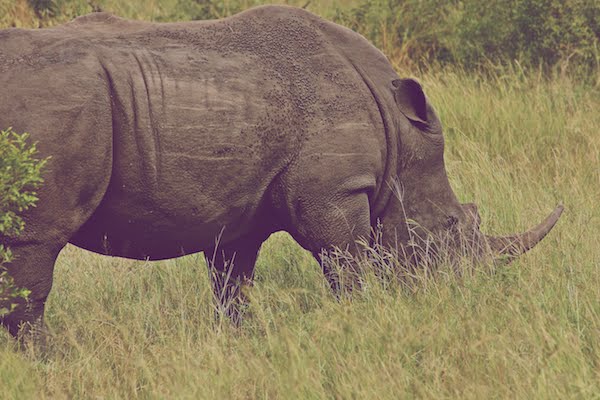
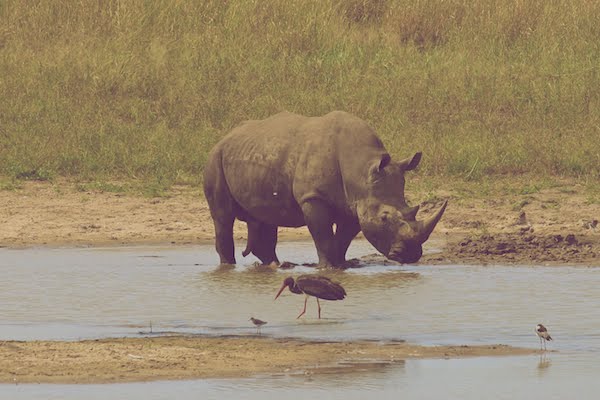
rhinoceros • 9 comments • Our rhino sightings were definitely less frequent than other animals. On each day we could would almost be guaranteed to see several giraffes, elephants, or zebras, but rhino sightings were very sporadic.Kruger Park contains two types of rhinos: the black rhino and the white rhino. Both types are actually gray in appearance, and there are only subtle differences between them. We primarily saw white rhinos, but we saw a single black rhino, wandering by itself (not pictured below).There was a poster in one of the base-camps showing a rhino carcass that had been left by poachers. The poachers will saw off the horns and leave the animal to die. Even within the highly protected gates of Kruger, poachers are still able to wreak havoc. Apparently ground-up rhino horns are (mistakenly) thought to be aphrodisiacs in some Asian countries even though the horn contains the same "ingredients" as your toe and finger nails.Rhinos are understood to be blind, and we heard that they will just randomly charge at things, so, again, we tried to keep our distance. Sometimes the animals would just come out of nowhere, so all you can do is hope that they're not going to run into your car.
water buffalo • 6 comments • It's hard for us to think about African buffalos (or water buffalos, as they're known locally) without being reminded of the Battle at Kruger video. Secretly hoping that would we see an epic battle between animals, we visited the watering hole (Transport Dam - where the video was filmed), only to find a lone hippopotamus. However, we did see our fair share of water buffalos in other areas of Kruger National Park. We were often surprised to see animals grazing by themselves in the park. Twice we saw water buffalos, on their own, making their way through fields. For some reason, we assumed that they needed to stay in groups at all times for survival. Since it was just the two of us in the car all day long, we had some very interesting (and sometimes uninformed) conversations about animal behavior. One of Mina's pet peeves is anthropomorphism, but we couldn't help but making up narratives about what the animals were up to (we were driving for a long time). Water buffalos seem like a rather ordinary animal to have included in the "big 5", but their inclusion is because of their unpredictability. The term "big 5" has it's origins in hunting, and the water buffalo (despite being an herbivore) can be a very unrelenting, aggressive, and dangerous creature. Several hundred people in South Africa are killed every year by them. We noticed that they were always aware of our presence. Zebra's and giraffes didn't seem to care about us, but water buffalos (and wildebeests) always seemed to know when we were nearby and they actively moved away. We treated them like the elephants; took a few photos, and then moved on - quickly! -Alex